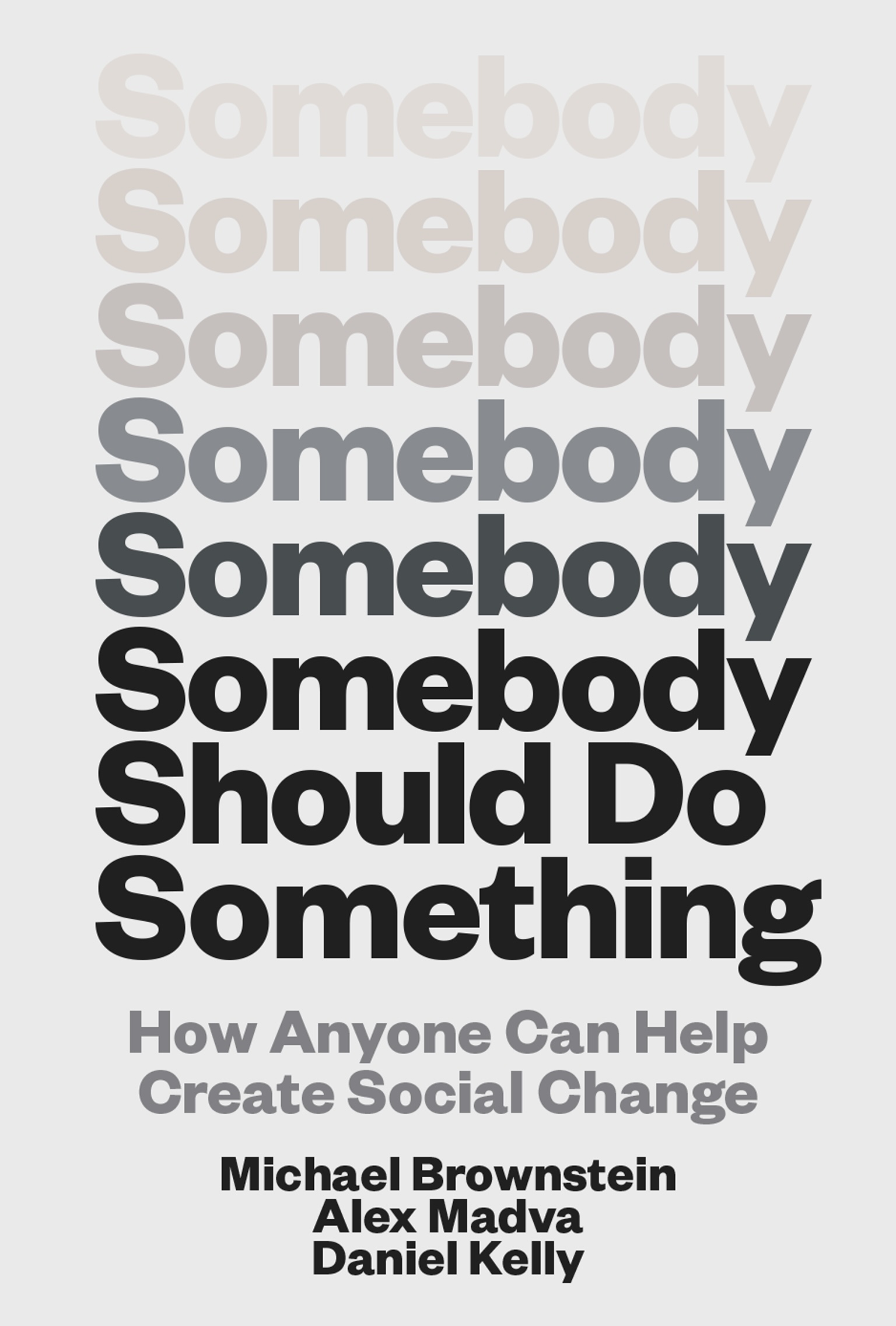
The three of us spent a long time feeling stuck about what we could do about the biggest problems we collectively face … It seemed to us that we were being forced to choose between personal choices or systems and social structures. This book is about getting unstuck. Our personal choices do matter, just not the way we usually think … personal choices are connected to systems and structural change.
Brownstein, Madva and Kelly, Somebody should do something: How anyone can help create social change
1. Introduction
This is Part 8 of my series Papers I learned from. The series highlights papers that have informed my own thinking and draws attention to what might follow from them.
Part 1 looked at Harry Lloyd’s defense of robust temporalism, a form of pure temporal discounting.
Part 2 looked at an argument by Richard Pettigrew that risk-averse versions of longtermism may recommend hastening human extinction. This was meant not as a recommendation, but rather as a way of putting pressure on standard arguments for longtermism. Part 3 looked at a reply to Pettigrew by Nikhil Venkatesh and Kacper Kowalczyk.
Part 4 looked at a paper by Maarten Boudry and Simon Friederich examining evolutionary arguments for AI risk.
Part 5 looked at a paper by Simon Goldstein and Cameron Domenico Kirk-Giannini on existential risk from language models.
Part 6 looked at a paper by Rhys Southan, Helena Ward and Jen Semler on a timing problem for instrumental convergence.
Part 7 looked at an anthology of papers on longtermism.
Today’s post looks at a book about systemic change.
2. Introducing the book
Michael Brownstein is Professor and Chair of Philosophy at John Jay College and Professor of Philosophy at The Graduate Center, CUNY. His research focuses on the intersection of science, ethics, and social change.
Alex Madva is Professor of Philosophy at Cal Poly Pomona, Director of the California Center for Ethics & Policy, and Co-Director of the Digital Humanities Consortium. His work centers on the intersections between the cognitive and social sciences and topics in philosophy of race and feminism, applied ethics (especially prejudice and discrimination), social and political philosophy, and phenomenology.
Daniel Kelly is Professor of Philosophy at Purdue University. His research focuses on issues at the intersection of philosophy of mind and cognitive science, moral theory, and evolution.
Effective altruists think a lot about systemic change. Issues of systemic change were at the center of what is often called the institutional critique of early efforts in effective altruism. Effective altruists have largely taken these critiques to heart and now organize more effectively towards systemic change in areas such as AI policy and biosecurity.
Brownstein, Madva and Kelly’s new book, Somebody should do something: How anyone can help create social change is an important trade book backed by decades of scholarly research related to systemic change. I think it is important to examine this book.
The rest of this post was written by Brownstein, Madva and Kelly.
3. Doing good visibly
In September 2025, the three of us published Somebody Should Do Something: How Anyone Can Help Create Social Change. It’s about the relationship between changing individuals—including ourselves—and changing institutions, laws, cultures—what we broadly call “social structures.”
For those interested in learning more about the book, they can check out its website. One thing there that readers of Reflective Altruism might be interested in is an appendix that dives deeper into the thorny scholarly details (since the book is written for a public audience).
One of the book’s main themes is the power of social influence. Since EAs have written about doing good versus doing good publicly (e.g., here and here), we thought we’d outline some of the ways we treat this issue in our book.
4. Putting peer pressure to work
This is the subtitle of economist Robert Frank’s excellent book, Under the Influence, on “behavioral contagion.” Frank shows, for example, how smoking is a meme. What’s the best way to predict whether someone will start smoking? Whether their friends and family do. But ditto for quitting!
After a sibling quits, your odds of quitting go up 25%. After a close friend quits, they go up 36%. And if your spouse quits, you’re 67% more likely to stop smoking. As the sibling, friend, or spouse of someone who is trying to quit, each of us has an opportunity to use this role for good, simply by choosing not to smoke ourselves, talking about concerns, and so on.
The idea scales up in several ways. One is by using social influence to shape larger groups of people, not just our friends and family. Smoking’s meme-ability is why secondhand smoke is truly dangerous, as Frank points out. When someone smokes in public, it can affect others by literally putting smoke in their lungs. But the social consequences are worse: public smoking—by making the habit look natural and cool—creates more smokers. Keeping smoke out of one individual’s lungs is a small benefit compared to keeping smoking out of the public eye.
This is the power of public prohibitions of unhealthy behavior. It’s a key part of why smoking rates plummeted from their mid-20th century peaks, as “whole groups of people were quitting in concert.”
The idea scales up in another way, as it’s not just about smoking. The same lessons apply to voting, climate action, and much else. How to predict who votes? Find out if their college dorm-mate votes. How to predict who puts solar panels on their roof? Found out whether their neighbors put up solar panels first. How to get people off the doomscroll and into the streets? Go to the protest and ask your friends to come along.
These examples operate like “situationist” social psychology in reverse. If we’re all so susceptible to social influence—to quitting smoking when our friends do, getting into solar when our neighbors do, voting and protesting when our roommates do—then we’re all also purveyors of social influence. As we put it in the book: we are all each other’s situation.
5. Overcoming pluralistic ignorance
Americans are in a bad way when it comes to knowing what other Americans think about important social issues. For example, when polled, 66-80% of Americans say they support national policies to mitigate climate change. But a 2022 paper finds that when people are asked to guess what percentage of other Americans support these same policies, their average estimate is 37-43%. Americans get the facts about popular support for national climate action almost exactly backwards, in other words. Public opinion supports these policies by a 2-to-1 margin, but people think public opinion is against them 2-to-1.
This isn’t specific to climate change. Like the power of social influence, “pluralistic ignorance”—when people mistake a minority position for a majority one—applies to a range of topics. There’s a century of research on our susceptibility to being confidently mistaken about what our peers believe, from immigration to abortion to climate change. Notably, research in political science finds that elected representatives also often mistake minority positions for majority ones.
The sources of pluralistic ignorance are complex, but at least part of the solution is doing a better job of making our choices and opinions known in public. Research on the dynamics of social networks suggests this is a central feature of “norm cascades,” like those we saw both for and against mask-wearing during the COVID pandemic. Once people feel safely ensconced in the majority, they’re much more willing to change their behavior.
Our opportunities for social influence on this front may be more than epistemic too. As we write this, we are watching horrors unfold in Minneapolis, where ICE agents are chasing, beating, and disappearing immigrants (and some citizens). A bright spot in the news has been the explosion of mutual aid in the city. Faith communities are organizing to honk horns and blow whistles to alert others of ICE’s presence; neighbors are taking turns standing guard outside schools; people are even doing laundry for strangers so they don’t have to risk a trip to the laundromat. We believe these actions are inherently laudable, but they also serve a crucial public function: they spotlight injustice and normalize resistance to it.
6. Surfacing the state
In 2008, the political scientist Suzanne Mettler found that 57% of a representative sample of Americans said that they had never used a government social program. Mettler then listed 21 such programs for these respondents, such as Social Security and unemployment insurance. It turned out that 94% of the people who said they had never used a government social program had used at least one. Incredibly, the average respondent had used four.
Studies like this formed the basis of Mettler’s book, The Submerged State: How Invisible Government Policies Undermine American Democracy. It offers a partial but compelling diagnosis of the success of small government conservatism in the USA. If people don’t know how the government is helping them, why would they want more of it?
So how do we surface the state? A necessary, though not sufficient, part of the answer is talking about it. Publicizing information about what government programs do for us can have surprisingly big effects. Mettler has tested the effects of simply making people aware of basic information about policies like tax credits for mortgages and low income workers, the latter of which lifts millions of families with kids out of poverty. She finds that people want to do more for their country once they appreciate what their country is doing for them.
7. Spillover
You might worry that your impact as an individual, in any of these examples, remains worryingly small. No matter how many people you tell about your new e-bike or the Earned Income Tax Credit, you’re still just a drop in the bucket of the clean energy transition and the federal government’s legislative agenda. From an EA perspective, it’s fair to wonder about the ROI relative to the effort involved.
We’re heartened, though, by evidence suggesting that small acts can lead to bigger ones: positive spillover. Sometimes doing a relatively easy but less impactful thing, like buying an e-bike—an example of “consumer activism”— leads people to do a harder but more impactful thing down the line, like joining an advocacy group, working for a pro-climate political candidate, or earning to give half their income to the Clean Air Task Force. Put in other words: building on our own small, individual actions and harnessing our social influence can complement, rather than substitute for, other forms of changemaking. Put in other words still: evidence for positive spillover mitigates worries about moral licensing (e.g., that people will take our advice and reason, “well I mentioned climate change to my friend today, so now I can drive my SUV to the airport for my trans-continental flight on which I’ll take the steak!”).
This kind of positive spillover is a form of intrapersonal social influence. Rather than shaping the situation in which others make their decisions, it’s a way of shaping the situation in which our future selves make their decisions: locking in an altruistic lifestyle and protecting against “value drift.”
8. Final thoughts, open questions
Social influence is underappreciated, multifaceted, and readily achievable for everyone. Of course, some people have more of it than others, and evidence of its effectiveness is stronger in some domains than others. Many open questions remain about what it entails, how it might backfire, and so on. Here are a few:
When is virtue signaling virtuous? We’re less concerned with the interpretation of this question that focuses on virtue as such (i.e., the evaluation of a person’s character). But we share concerns expressed by others in the EA community about when doing good publicly is effective and when it risks backfiring. It’s true but probably too easy to say that one’s intent matters; if you’re sharing your choices and values—and listening to others when they share theirs—because you care about the issues, your chances of moving somebody are probably much better than if you’re just in it for the likes and clicks. Another avenue worth pursuing focuses on your location in a social network. Damon Centola has shown how people respond much more favorably to social signals when they’re received from multiple, differently located people (e.g., if you hear Wall Street guys and soccer moms and Republican surgeons talking about their e-bikes). He’s also shown how receiving the same signal from the same person repeatedly can backfire (e.g., if the only vegan you know is that one annoying person who won’t shut up about it).
Likewise, when does spillover become positive—complementing harder, more consequential steps people can take to create change—and when does it become negative—substituting for those steps? The literature on this question is nascent. Although concerns about moral licensing are rampant, it’s clear enough that negative spillover isn’t fated. But identifying what helps a small act become a foot in the door of our conscience, or of our willingness to get more involved in fights for justice, or of our self-conception as someone who does these things, is a crucial and ongoing project.
Finally, what role does social influence play in responding to threats to democracy? We worry about what Brian Beutler has called the “median experience of tyranny,” which is the idea that for most people, most of the time, losing democracy feels unremarkable. It’s just another news story about bad things happening to other people. We worry that even as Americans’ day-to-day lives are affected—like hearing their pediatrician tell them they no longer follow the federal government’s vaccine recommendations—these changes won’t be self-interpreting. If you, like most Americans, pay little attention to politics, it’s not self-evident why your pediatrician is suddenly suspicious of the FDA. A task here for the social influence-minded is tracking and publicizing the loss of democratic state capacity. Just like with the Earned Income Tax Credit: if you don’t know what democracy was doing for you, why would you care about fighting for it?
Leave a Reply