
If you try to create a libertarian paradise, you will attract three deeply virtuous people with a strong commitment to the principle of universal freedom, plus millions of scoundrels. Declare that you’re going to stop holding witch hunts, and your coalition is certain to include more than its share of witches.
Scott Alexander, “Freedom on the centralized web“
Content warning: This post explicitly discusses racism and sexism, including the work of prominent advocates of race science. There is also discussion of the potential policy implications of these views, many of which are rather extreme. There is a strong prevalence of dehumanizing language, views, and other content that many readers may find offensive. I have not made any effort to censor this content; indeed, I have sought it out.
1. Introduction
This is Part 5 in a series on Human Biodiversity. Human biodiversity (HBD) is the latest iteration of modern race science. This series discusses the impact of HBD on effective altruism and adjacent communities, as well as the harms done by debating and propounding race science.
Part 1 introduced the series, explaining what HBD is and why propounding HBD is wrong. Part 2 discussed events at Manifest. Part 3 discussed Richard Hanania.
Part 4 began a two-part series discussing Scott Alexander, a leading figure in the rationalist community. Part 4 discussed Alexander’s own work. Today’s post discusses the community that has grown up around Alexander’s work. The purpose of this post is to provide a window into a community that overlaps substantially with mainstream portions of the rationalist movement, in order to get a better sense of what this community believes and how it behaves.
2. The ACX Survey
What do readers of ACX think about HBD? Fortunately, there is no need to speculate. Alexander conducts an annual poll of his readers and asks them straight out every year.
The 2024 ACX survey is the most recent and is reasonably representative. In that survey, Alexander asked his readers: “How would you describe your opinion of the idea of “human biodiversity,” eg the belief that races differ genetically in socially relevant ways?”. The answers ranged from 1 = “very unfavorable” to 5 = “very favorable”. Here are the results:

An astounding 31% of readers were favorable or very favorable towards HBD and only 40% were unfavorable, most of those weakly unfavorable.
The mere fact of asking readers for their opinions on such a question is shocking enough. That almost one in three are favorable towards HBD, and fewer than one in two unfavorable speaks volumes about the attitudes of ACX readers. Do not let it be said that Alexander is merely open to all opinions and thus lets a few HBD supporters onto his blog, just as a few communists or anarchists might wander in. These results show deep and wide-ranging levels of support for HBD in a large number of readers.
I am sure it will be objected that Alexander downplayed what HBD entails in stating the question, calling HBD “the belief that races differ genetically in socially relevant ways.” By this point in the series, I hope readers know that this does not begin to scratch the surface of what HBD claims. We have seen that mainstream defenders of HBD have definite hypotheses about the nature and extent of genetic differences in mind, usually taken directly from prevailing racial stereotypes. In particular, they often investigate the hypothesis that people of color are genetically disposed to be less intelligent and more criminal than others. (We will see below that defenders of HBD in the community around Alexander often do the same). This is quite far from the simple claim that “races differ genetically in socially relevant ways” and many respondents would have been in a good position to read between the lines here.
3. Callouts
One of the best ways to see how a community views race science is to consider what they do when called out for their behavior. Let’s look at two examples, spread out across time. The first is from 2017, the second from 2024.
3.1. On the commentariat
Some time ago, a thread was posted on the very active slatestarcodex subreddit entitled “On the commentariat here, and why I don’t think I can be associated with this community, despite liking the blog.”
The post cited the blog’s fascination with race science as the primary reason why the author did not want to be affiliated with the blog. The author wrote:
I think a lot of the ideas discussed [here] are very powerful, and I really want to share these with my friends. I have actually tried a few times, but the results have not been great.
Their issue has not really been with the content of Slate Star Codex overall. Actually, they positively responded to most of the ideas Scott discusses. However, they would scroll down to the comments, and immediately be repulsed. At first, I did not see what the big deal was, everywhere has their own weird commentariat, right? However, as time has gone on, on both the site and on the subreddit, their concerns have started to come into clearer and clearer focus.
These days, I go to the Open Threads, and a huge chunk of it is about how wrong the filthy SJWs are, about how most things the Blue Tribe are actually just virtue signaling, and HBD. I’ve also noticed Steve Sailer, a thought leader in the alt-right, has been commenting, and links to the Unz Review abound.
I then go to the subreddit, and the Culture War thread, which generally discusses what evil things the SJWs have done this week, sucks all of the oxygen out of the subreddit. The few posts left are generally about heritability of intelligence and ability, largely along lines of ethnic identification. I have noticed a steep uptick in these posts recently, and its starting to bother me a bit.
However, the straw that broke the camel’s back was the fact that Emil Kirkegaard posted here in the past few days. For context, Emil Kirkegaard is a complete unknown among most in genetics. The few that have heard of him consider him a complete laughingstock. He has no academic qualifications commensurate whatsoever with publishing behavioral genetics research and no association with any institutions of repute to booth. Most of his research is published in two non-peer reviewed “journals” that he edits. Indeed, he is most famous for pulling a bunch of data from OKCupid, without the consent of the company or the people whose data he used, and throwing it online without anonymizing the data, in clear violation of every single ethical standard set by IRBs anywhere, which could reveal the identities of basically all of the people in the dataset. His prior research basically looks at whether immigrants are disproportionately criminals with lower IQs and whether negative stereotypes about Muslims were true, using techniques nobody of repute in the field uses (which, unsurprisingly, ends up showing that Muslims and immigrants are criminals with low IQs). His post cherry picked data to show that race-mixing is bad for offspring. The only pushback he received was about how he probably doesn’t control for how many multi-racial children grow up in single parent households, which was not encouraging. Nobody challenged his “unorthodox” methods, his lack of qualifications, or his clear break with basically everyone in the field. This was even less encouraging, considering he posted this to a community organized around examining data rationally and rejecting bias.
Full disclosure, I am a doctoral student in population genetics at an R1 institution, and most of my friends in my cohort are also in population genetics. Every single one of them was horrified by the comments full of what they considered to be racist crackpots in a place that is supposed to be a bastion of rationality. HBD (and associated race/IQ stuff) is seen as a perversion of our field for the most part, and we are overall deeply suspicious of people who fixate on the heritability of IQ, for obvious reasons. I now feel like I cannot introduce anyone in my social circles to this community, who are exactly the kind of people who would get the best use out of it and would be great contributors here.
These are fair complaints, clearly and politely raised. How were these complaints taken? The top comment on this thread is from Alexander himself, who writes in defense of race science:
Your description of opinions among scientific experts doesn’t match eg Rindermann et al, Synderman and Rothman, Thompson on ISIR, etc.
Emil is definitely odd, but I notice he’s got some peer-reviewed publications co-authored with respected people in the field (example), his papers get cited in major journals, and he’s always talking to professors and PhD students on Twitter who seem to think he’s okay. I’m not going to say that SSC doesn’t have higher standards than peer-reviewed journals, because goodness knows we do, but I haven’t seen any reason to active them here.
I respect your opinion, but you’re one guy on Reddit, and disagreeing with every peer-reviewed survey of experts I’ve ever read, plus some professors I know personally, plus other people on this thread who also claim to be doctoral students.
It should by now come as little surprise that Alexander’s third link is to the Unz Review. (What might be more surprising would be Alexander’s claim to “have higher standards than peer-reviewed journals” in his blog and the surrounding community. When I talk about the value of peer review and the need to respect legitimate authority, this is exactly the kind of behavior that I am targeting.)
A few commentators do better. The second comment seems to recognize the problem with the prevalence of race science on Alexander’s blog, though suggests that they do not know of a “clean solution”.
A few comments down, ranked fifth, we get an appearance by Emil Kirkegaard himself. Kierkegaard has such a long rap sheet of racist, sexist, homophobic, and otherwise abhorrent views that only a full perusal of his RationalityWiki article could begin to do justice to his oeuvre.
Kierkegaard announces his intention “to make some general remarks as well as rebut some of the worse claims” in the original post, then launches into an extensive defense of race science. I won’t quote in detail from Kierkegaard’s remarks, but readers are welcome to read them here. As I speak, they sit at +48 Karma.
The eighth comment, sitting just below Kierkegaard at +45 Karma, is more direct:
I find it a bit disappointing that you feel so strongly about this that you made a post, but decided to make your main arguments an appeal to authority “X is considered a laughingstock among geneticists” combined with the worst argument in the world “the idea of human biodiversity and its empirical support makes HBD a noncentral member of the racist group, therefor[e] you should treat them like any other racists” As a doctoral student myself, i am disappointed that you would draw such attention to this qualification and manage to reflect so poorly on us.
The ninth comment again defends race science:
As for HBD, I’m actually curious: is HBD that wrong? My sense was that they were more overconfident than wrong per se. I certainly get annoyed at the gleefulness of it all (“ha! Those poor starving Africans have bad genes! Liberals are such idiots for wanting to help them!”), but I did not get the sense that they are completely wrong on their factual claims (though again, I think they’re overconfident).
The tenth comment directly notes the problem (that Kierkegaard had published an article entitled “Is miscegenation bad for your kids?” and shared it within the community), then defends Kierkegaard:
You mean where he posted this right?
I’m not really familiar with Emil, but I have no idea why you find that article so objectionable. He notes existing data that mixed race kids seem to have a tough time (higher depression rates etc), walks a few hypotheses through the data, and ends up….. not really concluding anything. If anything the impression it gave me was that it probably wasn’t anything to do with population genetics; that the most plausible explanations were social factors and selection effects.
The only specific criticism you leverage against it is that the data is cherry picked. Are you saying that you think the claim that multiracial youth have a disproportionately high level of mental health problems is incorrect, or grossly exaggerated? Because I searched Google Scholar for “multiracial outcomes” and “multiracial mental health” and it seemed to bear him out. Please explain.
While I am grateful for those readers who reacted better, it is clear that a sizable portion of readers think that it is acceptable to discuss, even defend race science and those who propound it.
3.2. Why does Scott like Hanania so much?
Part 4 of this series discussed Alexander’s review of Hanania’s book, The origins of woke. This review led to some pushback.
Shortly after the review was posted, a user on the Slate Star Codex subreddit submitted a post entitled “Why does Scott like Hanania so much?“. The post was short and to the point:
I enjoy Scott’s blog posts, but the recent book review surprised me. It seems clear from Richard Hanania’s Wikipedia page that he is a racist, for example writing “These people are animals” in reference to black people in 2023.
For me this would make it hard to review any of his works solely based on their content without believing he had a larger agenda behind them, especially a book on “wokeness”. Scott doesn’t seem to address this at all, which feels quite disconcerting to me. Any thoughts on why?
The outrage was, however, decidedly lacking. The top two comments defend the view that it should be appropriate to enter into discourse with racists (see here and here).
The next two comments get to the point. The third approvingly references an article widely regarded as a covert defense of HBD:
The Kolmogrov Complicity is one of my favourite articles by Scott. I don’t think it is that subtle.
The fourth concurs:
Are we going to pretend that Scott isn’t a soft race realist?
The fifth suggests that Hanania “has had a change of heart” (which we saw in Part 3 is quite doubtful).
The sixth comment echoes the first two in defending open-minded dialogue with those we disagree with.
It is not until the seventh comment that we get genuine outrage. Only, that outrage is directed in the wrong direction.
Why on EARTH would you assume he meant the word animals to be “in reference to black people“?
There is nothing in the tweet to suggest it. The only way you could come to the conclusion “by animals he means black people!” is to engage in the sort of nonsense tribalistic reasoning your main question suggests. Which is to say: “People Who Know have already established he is a Bad Person who is Bad so anything he says must be interpreted in ways which reinforce the narrative that he is Bad and we (who denounce him) are therefore Good, no matter how tortured an interpretation that requires.”
He’s in favor of law and order and peaceful subway cars. He’s in favor of good samaritans protecting the weak from scary possibly-deranged predators, even if those predators happen to be black but obviously not limited to black ones. And he’s against people-in-suits who refuse to prosecute criminals but bring charges against good samaritans who are trying to protect the public – whether or not the people-in-suits or the good samaritans happen to be black.
He’s using “animals” to mean those who can’t be reasoned with. You can’t reason with a bear, you can’t reason with a crazed subway stalker…and you can’t reason with a woke DA who brings charges against the wrong people. That’s what makes them animals, not their melanin count.
Hence the tweet.
(the tweet was: “Daniel Penny getting charged. These people are animals, whether they’re harassing people in subways or walking around in suits.”)
So your example doesn’t work – it does not constitute a racist statement at all, much less one from 2023.
So far, we have seen that almost half of the top comments try to paint Alexander as merely engaging in open-minded dialogue, while the other half acknowledge (without outrage) that Alexander probably has other motives. The first genuine instance of outrage suggests without evidence that a tweet stating “These people are animals, whether they’re harrassing people in subways or walking around in suits” was somehow referring to a nebulous class of people who cannot be reasoned with (including bears, subway stalkers, and woke DAs).
There was an opportunity here to call Alexander out for bad behavior. The opportunity was missed, by some because they pretended not to know this behavior for what it was, and by others because they saw clearly what was going on and could not muster enough outrage to object.
4. The culture war threads
4.1 Introducing the culture war threads
As might have been expected, the open forum of /r/SlateStarCodex soon came to be dominated by what readers would term “culture war” topics. The volume of culture war discussion grew so large that it threatened to take over the subreddit.
The solution to this problem was to confine discussion to a single recurring “culture war” thread. As Alexander puts it:
As per the usual process, the topics that generated the strongest emotions – Trump, gender, race, the communist menace, the fascist menace, etc – started taking over. The moderators (and I had been added as an honorary mod at the time) decreed that all discussion of these topics should be corralled into one thread so that nobody had to read them unless they really wanted to. This achieved its desired goal: most of the subreddit went back to being about cognitive science and medicine and other less-polarizing stuff.
Unfortunately, that is not quite what happened. Alexander reflects that:
Unexpectedly, the restriction to one thread kick-started the culture war discussions rather than toning them down. The thread started getting thousands of comments per week, some from people who had never even heard of this blog and had just wandered in from elsewhere on Reddit. It became its own community, with different norms and different members from the rest of the board.
A famous postmortem of The Motte – a successor to the Culture War thread that will be covered in the next post – goes even further:
It was by far the most popular thread any given week, and it totally dominated the subreddit. You came to r/slatestarcodex for the Culture War thread.
What kind of a community grew up around the culture war thread? Certainly, the thread was open to many opinions, but some opinions grew to be more prominent than others. The same postmortem continues:
If I’m not being generous, I might describe it as an outlet for people to complain about the excesses of “social justice.” But maybe that’s not entirely fair. There was, I thought, a lot of good stuff in there (users like BarnabyCajones posted thoughtful meta commentaries) — and a lot of different ideologies (leftists like Darwin, who’s still active on his account last I checked and who I argued with quite a bit). But even back then, at its best (arguable, I guess), there were a lot of complaints that it was too conservative or too “rightist.” A month didn’t go by without someone either posting a separate thread or making a meta post within the thread itself about it being an echo chamber or that there wasn’t enough generosity of spirit or whatever. At first, I didn’t agree with those kinds of criticisms. It definitely attracted people who were critical of a lot of social justice rhetoric, but of course it did. Scott Alexander, the person who this whole subreddit was built around and who 99% of us found this subreddit through, was critical of a lot of social justice rhetoric.
There were, to be fair, a sprinkling of feminists and anti-racists involved in these discussions. However, these authors too complained about the general inclinations of participants and moderators. As one prominent feminist participant in the Culture War Thread reflects:
The Culture War Thread had a vast array of ideological views represented in it, but there was one viewpoint that was particularly disliked by the main conglomeration of posters, and it was — well, me. The internet feminists. People who could use words like “patriarchy” and “intersectional” and mean them. The Social Justice Warriors, the woke, the whatever-I-am-supposed-to-call-you-people. I was one of Them. The Repugnant Cultural Other. The Outgroup. The red flag in front of the bull. The moderators wanted to be mostly viewpoint-neutral, but I knew I’d be more likely to be reported to them in the first place. Some of the commenters believed deeply in trying to listen to the people who most enrage you, but many were around for the like-minded people they could find there.
Unsurprisingly, commentators sympathetic to what readers of Slate Star Codex might call “social justice” positions had a tendency to become exhausted and leave the thread.
What kind of behavior had emerged on the thread before its cancellation in early 2019? By far the best way to get a sense of the discussions on the culture war thread is to read them. It is not possible to convey, in a few short words, an adequate sense of how such a lengthy discussion proceeded. But I do think that several incidents on the thread may be revealing.
One challenge that I frequently encounter in criticizing bad behavior is that the behavior is claimed to be unrepresentative, since it is inevitably the behavior of some individuals and not others. There is, of course, some truth to the charge of unrepresentativeness: I focus on examples of egregious misbehavior to highlight the degree of misbehavior that might be tolerated.
I think that a good compromise is to focus on comments and discussions that were visible and received significantly positive karma. That does not show that these behaviors were typical of the thread, but it does go some way towards illustrating the kinds of behaviors that could be visibly engaged in and positively received. Let us consider two examples below – one from inside of the thread and one from elsewhere on Slate Star Codex.
4.2 White advocacy
In response to a blog post critical of race science, one user posted the following defense of white advocacy, including some very blunt strategic advice on how it might be made more palatable to mainstream audiences. (The comment sits at +41 karma at the time of archiving).
The alt-right spends much time dismissing what we call “IQ nationalism”, univariate models of “person-goodness” that tend to center around IQ. The goal of identitarian politics is to graduate newcomers from “thin hereditarianism” (thinking of single or isolated traits) to “thick hereditarianism” (seeing groups as having patterned differences that shape the societies they create). The purpose of IQ discussion is to focus the conversation, to force people (like the author of this post) who are hostile to the entire project of describing human differences by confining the discussion to a single trait that has large differences that are undeniably important to explaining outcome gaps.
… [IQ arguments] are entry points to non-universalist thought. Intelligence and violence are important, but not foundational; Few people disown their kin because they’re not smart. The purpose of white advocacy is not mere IQ-maximization to make the world safe for liberal-egalitarianism; Ultimately, we value white identity in large part because of the specific, subjective, unquantifiable comfort and purpose provided by unique white aesthetics and personalities as distinct from non-whites and fully realized in a white supermajority civilization.
However, one cannot launch into such advocacy straight away, because it is not compatible with the language of universalism that defines contemporary politics among white elites. That shared language, on both left and right, is one of humanist utilitarianism, and fulfillment of universalist morals with no particular tribal affinity. Telling the uninitiated Redditor that he would experience greater spiritual fulfillment in a white country is a non-starter, not on the facts, but because this statement is orthogonal to his modes of thinking.
Most people come into the alt-right from a previous, universalist political ideology, such as libertarianism. At some point, either because they were redpilled externally or they had to learn redpill arguments to defend their ideology from charges of racism/sexism/etc, they come to accept the reality of group differences. Traits like IQ and criminality are the typical entry point here because they are A) among the most obvious and easily learned differences, and B) are still applicable to universalist thinking; that is, one can become a base-model hereditarian who believes in race differences on intelligence without having to forfeit the mental comfort of viewing humans as morally fungible units governed by the same rules.
This minimal hereditarianism represents an ideological Lagrange point between liberal-egalitarian and inegalitarian-reactionary thought; The redpilled libertarian or liberal still imagines themselves as supporting a universal moral system, just one with racial disparate impacts. Some stay there and never leave. Others, having been unmoored from descriptive human equality, cannot help but fall into the gravity well of particularism and “innate politics” of the tribe and race. This progression is made all but inevitable once one accepts the possibility of group differences in the mind, not just on mere gross dimensions of goodness like intelligence, but differences-by-default for every facet of human cognition.
The scope of human inequality being fully internalized, the constructed ideology of a shared human future cedes to the reality of competing evolutionary strategies and shared identities within them, fighting to secure their existence in the world.
In this comment, the author advocates for a move to what they term thick hereditarianism, “seeing groups as having patterned differences that shape the societies they create.” This general view about patterned differences is soon replaced with a concrete theory: white people are not only more intelligent and less criminal than others, but in fact promote a whole host of socially desirable characteristics:
Intelligence and violence are important, but not foundational; Few people disown their kin because they’re not smart. The purpose of white advocacy is not mere IQ-maximization to make the world safe for liberal-egalitarianism; Ultimately, we value white identity in large part because of the specific, subjective, unquantifiable comfort and purpose provided by unique white aesthetics and personalities as distinct from non-whites and fully realized in a white supermajority civilization.
This is, as the author realizes, quite unpalatable to most people. As a result, the author suggests that readers be eased into more radical forms of racism through a minimal hereditarianism focused on intelligence and criminality:
Most people come into the alt-right from a previous, universalist political ideology, such as libertarianism. At some point, either because they were redpilled externally or they had to learn redpill arguments to defend their ideology from charges of racism/sexism/etc, they come to accept the reality of group differences. Traits like IQ and criminality are the typical entry point here because they are A) among the most obvious and easily learned differences, and B) are still applicable to universalist thinking; that is, one can become a base-model hereditarian who believes in race differences on intelligence without having to forfeit the mental comfort of viewing humans as morally fungible units governed by the same rules.
Here, we see an explicit defense of a strategy which uses discourse about racial differences in intelligence and criminality as an entry into broader far-right views. This is important because it is precisely this discourse about intelligence and criminality that occupies a large part of HBD discussions in rationalist spaces.
Perpetuating racist views about the distribution of traits such as intelligence and criminality is bad enough, but we need to be clear about what those discussions are being used to do. It appears that many readers of the culture war threads were able and willing to look clearly at a frank description of what these discussions were being used to do, advocating just such a form of “redpilling” into alt-right views, and upvote it.
4.3. The fourteen words
It should not be said that misbehavior was confined to the Culture War Thread. Let us consider an incident from elsewhere on Slate Star Codex.
The “fourteen words” refers to a 14-word white supremacist refrain. As the Anti-Defamation League puts it:
“14 Words” is a reference to the most popular white supremacist slogan in the world: “We must secure the existence of our people and a future for white children.” The slogan was coined by David Lane, a member of the white supremacist terrorist group known as The Order (Lane died in prison in 2007). The term reflects the primary white supremacist worldview in the late 20th and early 21st centuries: that unless immediate action is taken, the white race is doomed to extinction by an alleged “rising tide of color” purportedly controlled and manipulated by Jews. Because of its widespread popularity, white supremacists reference this slogan constantly, in its full form as well as in abbreviated versions such as “14 Words”, “Fourteen Words,” or simply the number “14.”
There is no ambiguity in what is meant by uttering the fourteen words. Indeed, they are sometimes followed by a second collection of fourteen words: “… because the beauty of the White Aryan woman must not perish from the earth.”
In 2017, one user began a (heavily upvoted) thread posing the question, “What are some true beliefs deep down you knew were true but didn’t believe at one time because they were too uncomfortable to accept?” It is not difficult to predict the types of beliefs that were soon mentioned.
One user defended the view that we should seek to live in ethnically homogenous communities. They were challenged by someone else to explain why the merely radical goal of cultural homogeneity could not be enough. In response, they wrote the following (the comment has 46 karma at the time of archiving):
The quick answer would be “because culture is heritable as well”, so one tends to look like the other in practice. The more narrow the cultural filter, the closer genetically the population will be just by being selected for indirectly.
The more nuanced answer I will offer for consideration is this: Because racial nationalism is a viable political reality in a way that my preferred “cultural nationalism” is not.
Foundational values are a political technology that lossily compresses ideology into something more memetic. The hope is that the public, seeded with this foundational value, unpacks it into something resembling the world you want. National identity only has room for a few of these core memes that ground the mythos of that nation, can be assumed by participants of public debate, and are transferred mostly intact from one generation to the next.
It is entirely possible for me to fall in love with a country that isn’t supermajority white; I just have no confidence that such a country is a plausible reality. “Civic nationalism”, as the alt-right calls it, is not a stable political equilibrium. It’s begging to be co-opted and subverted by a more memetic identity politics, as is happening now to conservatives who have no counter to the left’s IDpol argumentative superweapons. The (cultural, nonwhite) left keeps arguing, successfully and correctly, that “free markets”, “free speech”, and “law and order” are implicitly white and must be ceded as core values if America is to be not-racist.
I spent years trying to deconstruct those attacks, making non-racist arguments in favor of classical liberalism, but unlike policy debate club politics does not reward scoring lots of points and having an effective spread of citations. Right now, anti-racism is a magic button that my opposing tribe can push to win any debate, and my tribe has no means of disarming it because we get caught in racial disparate impact, implicit whiteness, privilege, or other such argumentative sandtraps. The left can organize a dozen protest marches in the time it takes us to say “when you control for applicant qualifications discounted for affirmative action, there is no net racial discrimination in the ____ sector.” At some point I realized most weren’t honestly seeking an accounting of racial gaps; It was just something they could stick you with and disqualify you from debating while they rallied their side into collective action around passionate appeals to blood and heritage. The proper response, to me, was to stop litigating facts and respond in kind, rallying my own tribe by saying “yes, white privilege exists; it’s fantastic, and we’d like more of it, thanks.”
I have no idea how to make politics more libertarian, more secular, more high-trust, more “rationalist”, more deferential to lawful authority, more process-oriented and constitutionalist, or any of the other things I value. I do know that white countries more frequently share my values than non-white ones, and we can maintain whiteness more reliably than we can hold constant all of the other values that load on that axis. It’s not my ideal, but I feel safer in that space than trying to construct utopia. My ideal would be to beam the combined writings of Slate Star Codex into the heads of my countrymen as the foundation of civil political discourse, but their minds are not fertile ground for such messages and it would take too long to convert them.
Or, to put it another way, if I am to seed our culture with one message, recognizing that this message would need time to take root, and would exist in a competitive environment with other memes, would I rather choose A) the United States Constitution and associated Enlightenment writings, or B) the 14 Words? The latter may have more staying power in practice.
Let’s be clear. Advocating racial nationalism and an increase in white privilege is frightening and would, in any other context, deserve detailed comment in its own right. However, the last paragraph of this comment literally suggests that the commentator would rather “seed our culture” with the message of the 14 words than the message of “the United States Constitution and associated Enlightenment writings.”
This is open, unfiltered advocacy of a white supremacist slogan as the basis for a white nationalist society. One would hope that such a comment would have been chased off of the forum, or at the least heavily criticized, or at the very least enjoyed net negative karma. None of these eventualities came to pass.
4.4. Closure of the Culture War Thread
Eventually, the Culture War thread became too much even for Alexander to bear. In 2019, the thread was closed, but Alexander expressed few regrets.
Proclaiming, “The Thread Is Dead, Long Live The Thread,” Alexander emphasized that the thread was not dead, but rather migrated to a new home:
As a final middle-finger at the people who killed the Culture War thread, I’d like to advertise r/TheMotte, its new home, in the hopes that this whole debacle Streisand-Effects it to the stratosphere.
We will speak in the next post about how the Culture War thread evolved in its new home on The Motte, as well as subsequent homes after that subreddit was closed down. Readers will be unsurprised to know that behavior grew worse after each relocation of the thread.
5. Rationalist defenses of Alexander
In preparation for later posts, which will focus on the broader rationalist community, it might be worth considering how the rationalist community reacted to Alexander.
In particular, I want to focus on the incident described in Part 4 of this series, where Alexander was publicly accused of racism by the New York Times, after which Topher Brennan leaked an email in which Alexander (allegedly) expresses considerable sympathy for race science.
One might suspect that the rationalist community would have rallied together to get rid of the bad apple. They certainly rallied together to excommunicate somebody. However, that somebody was Brennan.
Eliezer Yudkowsky wrote:
I feel like it should have been obvious to anyone at this point that anybody who openly hates on this community generally or me personally is probably also a bad person inside and has no ethics and will hurt you if you trust them and will break rules to do so, but in case it wasn’t obvious consider the point made explicitly. (Subtext: Topher Brennan. Do not provide any link in comments to Topher’s publication of private emails, explicitly marked as private, from Scott Alexander.)
In reply to a commentator, Yudkowsky continues:
“Anybody who hates on Scott Alexander cannot possible be good” ought to be obvious to the point where even *I* shouldn’t need to bother pointing it out.
And in case it was not clear that Brennan is to be excommunicated, Yudkowsky writes:
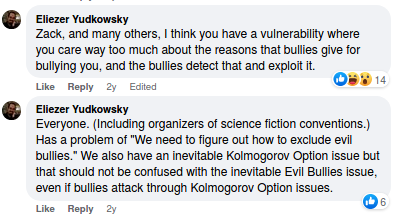
Everyone … has a problem of “we need to figure out how to exclude evil bullies.”
More generally, how did the rationalists react to the New York Times’ reporting about racism and Slate Star Codex and subsequent fallout? Here is the main thread on LessWrong discussing the New York Times article and subsequent deletion of Alexander’s blog.
The top comment quotes a Twitter thread by Richard Ngo arguing that “Scott Alexander is the most politically charitable person I know. Him being driven off the internet is terrible.”, though to Ngo’s credit he does go on to defend the New York Times.
After a comment linking to a metaculus prediction thread, the next comment advises readers on who they can email at the New York Times to prevent publication. Further comments are generally supportive of Alexander.
A LessWronger then sat down in 2024 to interview Cade Metz, the New York TImes reporter who broke the story on Alexander. He attempts to paint Metz as a dishonest reporter, for example:
You [Metz] wrote: “In one post, [Alexander] aligned himself with Charles Murray, who proposed a link between race and I.Q. in “The Bell Curve.” In another, he pointed out that Mr. Murray believes Black people “are genetically less intelligent than white people.”” End quote. So, the problem with this is that the specific post in which Alexander aligned himself with Murray was not talking about race. It was specifically talking about whether specific programs to alleviate poverty will actually work or not. This seems like a pretty sleazy guilt-by-association attempt. I’m wondering—as a writer, are you not familiar with the idea that it’s possible to quote a writer about one thing without agreeing with all their other views? Did they not teach that at Duke?
The top comment paints Metz as a bully:
To me this reads as a person caught in the act of bullying who is trying to wriggle out of it. Fair play for challenging him, yuck at the responses.
The next suggests:
But the skill of reporting by itself is utterly insufficient for writing about ideas, to the point where a journalist can forget that ideas are a thing worth writing about. And so Metz stumbled on one of the most prolific generators of ideas on the internet and produced 3,000 words of bland gossip. It’s lame, but it’s not evil. He just seems not bright or open minded enough to understand different norms of discussion and epistemology than what is in the NYT employee’s handbook.
The following two comments suggest the lesson that one should be extremely cautious in talking to journalists.
It is not until the sixth comment that we hear the truth:
I think for the first objection about race and IQ I side with Cade. It is just true that Scott thinks what Cade said he thinks, even if that one link doesn’t prove it. As Cade said, he had other reporting to back it up. Truth is a defense against slander, and I don’t think anyone familiar with Scott’s stance can honestly claim slander here.
Keep in mind that this thread was posted in 2024. The vast majority of the evidence about racism by Alexander and his followers that I have been cited was publicly available when this thread was posted. Rationalists were deeply familiar with Alexander’s work and could hardly be surprised by Alexander’s relationship to race science.
Despite all of this, Metz was described in the post as engaging in “a pretty sleazy guilt-by-association attempt” because he is “not familiar with the idea that it’s possible to quote a writer about one thing without agreeing with all their other views” and in top comments as “not bright or open minded enough to understand different norms of discussion.” It is as if, in 2024, rationalists were still clinging to the idea that Alexander were merely engaging in open-minded discussion with bigots, despite direct evidence to the contrary.
There is not much evidence that the rationalist community has learned from Alexander’s behavior. The community has made no concerted effort to distance itself from Alexander, and little effort to control or criticize Alexander’s discussions of race science. We will see in the next post that while behavior on LessWrong is generally not as bad as the behavior discussed so far in this series, it is a far cry from acceptable.
6. A gathering of witches
We began this post with an observation by Scott Alexander:
If you try to create a libertarian paradise, you will attract three deeply virtuous people with a strong commitment to the principle of universal freedom, plus millions of scoundrels. Declare that you’re going to stop holding witch hunts, and your coalition is certain to include more than its share of witches.
This line of reasoning has been used by many to suggest that the witch problem on ACX and allied communities is a natural consequence of the rationalist commitment to open dialogue.
On this way of viewing the matter, one expects that rationalist communities might be populated with a rich variety of witches, including communists, mujahideen, child pornographers, Iranian nuclear scientists, Cuban dissidents, and people who boil their Brussels sprouts. And to be fair, the community does have some representation from many witching communities.
However, it is at least passing strange that despite the community’s openness to many types of witches, it has come to dramatically over-represent a single type of witch. We saw in this post that many communities within and adjacent to ACX show high degrees of sympathy for HBD, to the point that support for HBD hovers around thirty percent in polls and that for years the community’s forum was dominated by a Culture War thread hospitable to just this sort of witch. We saw in the previous post that Alexander himself at least flirts heavily with just this sort of witchcraft. There are, of course, selection effects in group formation. But this is a suspiciously large effect.
It is common for those engaged in egregious behaviors to paint themselves as defenders of important moral principles. They are not, in their minds, simple racists but rather advocates of open discourse, defenders of persecuted scientists, staunch libertarians, or hosts of one of the last true public fora in an increasingly polarized age. There is, perhaps, something to these claims, but we need not take them at face value, even if they are genuinely internalized and believed by their utterers.
It is quite possible to remain committed to all of these principles while pushing back sharply against the increasing platforming of HBD on ACX and adjacent communities. This is especially true when, as we have seen, the composition and behaviors of these communities is difficult to explain by appeal to principles alone.
With regard to the libertarian paradise that early rationalists may have envisioned, I think we should confidently say: this is not it.